
CSLabs Awarded a Direct to Phase II Navy SBIR Next-generation Autonomy for Unmanned Maritime Vehicles (UMVs)
September 1, 2024
CSLabs is advancing AI-Routes, an AI-enabled autonomous navigation solution for unmanned maritime vehicle (UMV) swarms, enabling operations in dynamic environments and complex missions. Originally developed under an Army Phase I SBIR and further matured through internal research and development (IR&D), AI-Routes is now being advanced for Navy applications. Leveraging Dynamic Dimension Technologies’ VxSIM simulation framework, AI-Routes optimizes navigation paths and behaviors using mission and real-time sensor data. The framework enables collaboration among heterogeneous UMVs, allowing swarms to perform complex tasks across a variety of scenarios.
Under SBIR contract N00014-24-C-1332, the technology will undergo a staged testing process—beginning with simulation-based evaluations and progressing to real-world maritime trials. These demonstrations will validate core swarm autonomy behaviors while additional testing will expand capabilities and inform future integration planning.
Specifications Required
This technology requires UMV platforms equipped with sensors that provide spatial awareness for navigation and the detection/classification of friendlies, adversaries, or neutral vessels. Platforms may include heterogeneous capabilities such as varying sensor packages or maneuvering performance. Communication systems (e.g., satellite links) are assumed for state-sharing across the swarm, with built-in resilience for limited communication.
Technology Being Developed
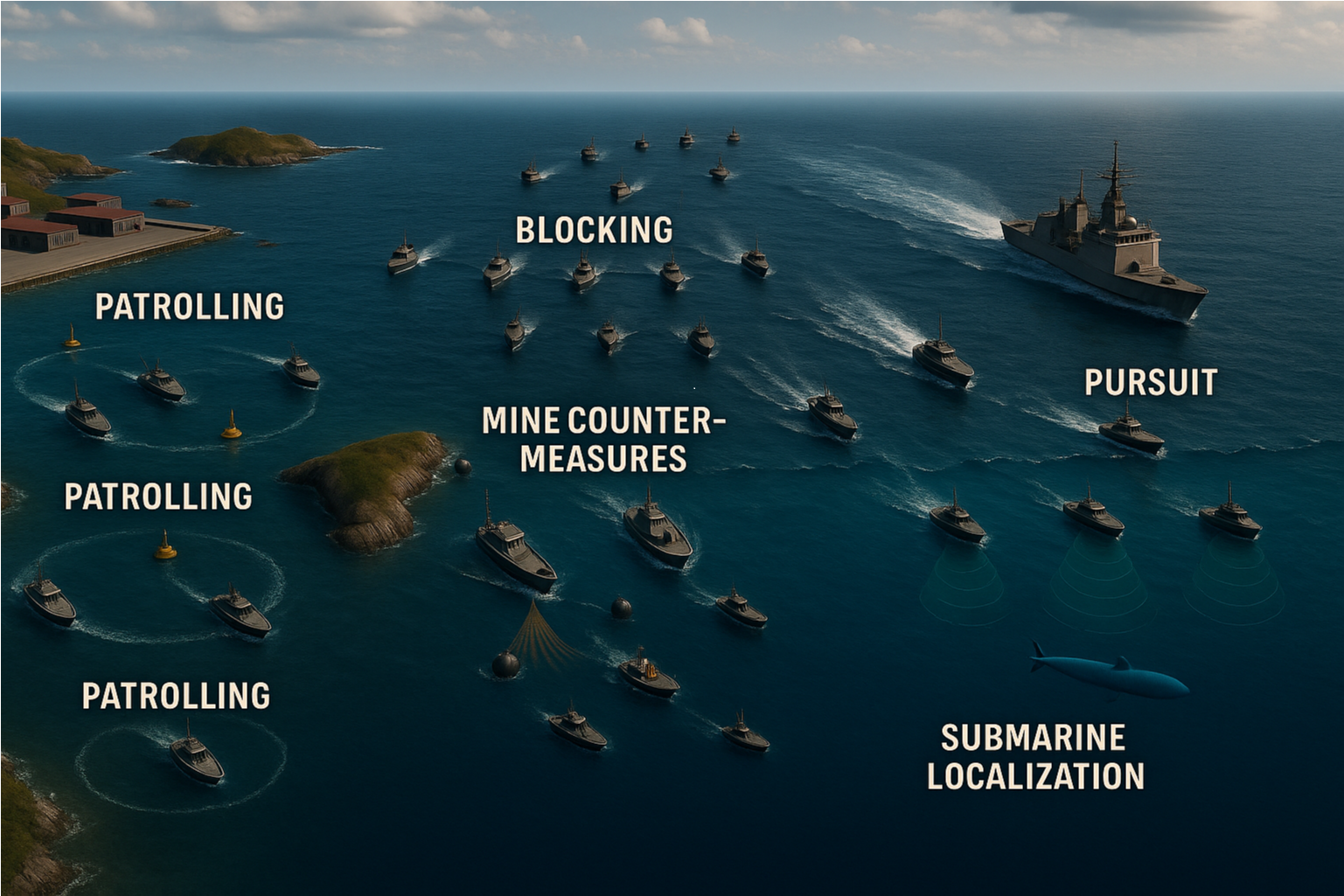
The autonomy framework will enable UMV swarms to coordinate and adapt their actions based on mission objectives, environmental context, and shared situational awareness. Supported behaviors include patrolling, blockading, pursuing, and intercepting. Each UMV dynamically adjusts its behavior, enabling effective collaboration with minimal operator input. Simulation and in-water testing will be conducted to demonstrate core behaviors, with additional trials planned to refine adaptability and scalability.